
2023-09-26
By Isabela Pérez Garrido
Ecuador made a constitutional commitment in 2008 to uphold and protect social rights, collective citizens, Indigenous livelihoods, and the rights of nature by including the Sumak Kawsay Indigenous worldview of living in harmony with nature as a core constitutional value.
Despite this formal obligation, empirically there is still an incongruency between Indigenous Peoples’ realities and the promises the constitution envisioned to protect.
This is due to the deeply ingrained colonial structures of otherness and ethno-racial exclusion that persist in the country, which is home to around 1 million Indigenous Peoples. By 2019, the country’s poverty incidence was 51.1% for Indigenous Peoples, making them the most marginalized social group in Ecuador, according to 2019 data from the Banco Central del Ecuador. Additionally, recent studies show that by 2021 the average years of schooling for Indigenous Peoples was 7.24 years, the lowest among Ecuador’s ethnicities.
Likewise, due to the resource-dependent economic structures in the country, Indigenous Peoples’ territories are continuously threatened, contaminated, and destroyed. Moreover, challenges are growing grimmer for Indigenous youth as they live in an extraordinarily complex environment, one where they have to manoeuvre between contradictions of being young in a globalized world, while at the same time upholding ancestral traditions.
"By voicing the need for change in Ecuador and bringing forward innovative strategies, Ecuadorian Indigenous youth defenders are playing a key role in the promotion of Indigenous rights and identities in this country."
The author, Isabela Pérez Garrido
Nonetheless, Ecuadorian Indigenous Peoples are robust political actors who are continuously challenging these injustices, and Indigenous youth have taken a lead in the promotion of these social transformations. They are bringing forward innovative strategies to promote collective rights and enhance Indigenous identities in modern-day Ecuador.
For instance, the historic referendum carried out on August 20, where Ecuadorians voted to protect the Yasuní National Park by banning oil drilling in one of the most biodiverse regions in the planet and home to the uncontacted Indigenous tribes Taromenane and Tagaeri, was made possible largely through the support of Ecuadorian Indigenous youth defenders. These young people are acting individually or sometimes in collectives to promote rights in the country.
Using technology to induce change
A key strategy of Indigenous youth defenders for the promotion of collective rights in Ecuador is the use of social media platforms, such as Instagram, Facebook, TikTok, Twitter etc. Ecuadorian Indigenous youth defenders acknowledge using these technologies in their defence, as they are a powerful tool to visualize breaches of their rights, demand the fulfilment of their claims, broadly educate people about Indigenous Peoples and their inherent rights, and empower Indigenous individuals about their rights and identities.
For instance, Indigenous youth defenders have turned to these platforms to report and denounce oil spills, cultural appropriation situations, and violations to their livelihoods. As one defender said, “I use it [social media] when there are terrible things happening like oil spills, [or when there] are protests. I do use social networks as a tool of struggle because it is very important for the world to know what is happening.”
These strategic communication posts, which bluntly showcase the severity of the problems and many times also directly link authorities and those responsible, have induced processes of information-sharing across these digital territories. This means that these communications reach large numbers of people who help share and support the Indigenous Defender’s claims; increase the pressure and sense of urgency to remedy and draft solutions for these violations; and create a greater social acknowledgement of the need to uphold collective rights, indigenous livelihoods, and their identities in the country.
For example, the impact of these communications is evident in Indigenous defender Helena Gualinga’s Instagram posts, a platform where she has more than 100,000 followers. She uses her posts to voice her opposition to mining and oil exploitation in the Ecuadorian Amazon, support for the territorial protection of her community, and the importance of indigenous identities.
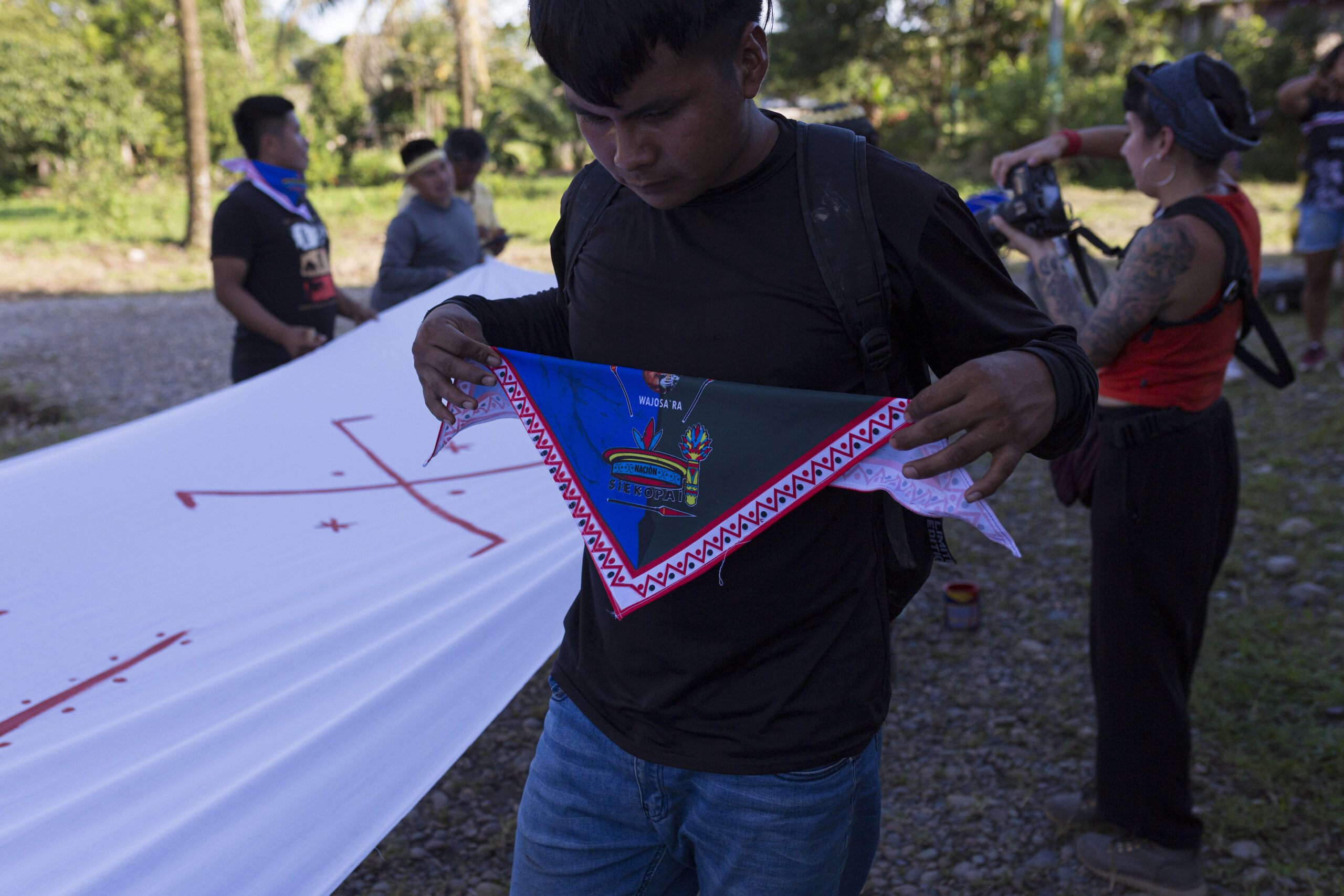
Sparking dialogue and change
Another crucial strategy employed by Ecuadorian Indigenous youth defenders is the incorporation of the changes they desire to see in their everyday activities, enabling change to happen. To do so, Indigenous youth defenders are initiating conversations, communal brainstorming, and other practices in their own social circles, to start new daily routines that spark change in seemingly unnoticeable ways.
For example, Kichwa clubs that promote Indigenous identity revitalization are being inaugurated, conversations about feminism and the importance of Indigenous women are being suggested in communal weaving sessions, and the practice of using their traditional garments in non-traditional spaces are all being promoted by Indigenous youth defenders. These strategies are silently empowering Indigenous Peoples in Ecuador to uphold their rights and identities and are also helping transform spaces within the country so that collective rights are properly respected.
By voicing the need for change in Ecuador and bringing forward innovative strategies, Ecuadorian Indigenous youth defenders are playing a key role in the promotion of Indigenous rights and identities in this country. They are dynamizing the process for change and they are helping generate transformative spaces both digitally and physically where Indigenous Peoples can dictate their own rules, identities, and wellbeing. It is because of them that Ecuador can dream to become a country where the Sumak Kawsay worldview, inclusiveness, and respect can be truly upheld.
Hence, Ecuador becomes an example of why more recognition paired with formal support needs to be granted to Indigenous youth as they are key actors in transforming our societies into inclusive and just ones.
Isabela Pérez is a recent graduate of Lund University in Sweden and a former Tenure Facility intern and collaborator. This article is adopted from her Master’s Thesis in International Development and Management: Bridging the past, the present and the future: Ecuadorian indigenous youth defenders’ role in the creation of just social change in Ecuador.
Articles